


Must the definition come first?
We disagree about what consciousness is, how to define it, and even what would count as explaining it. But I believe we may still be able to measure its effect.

At a Polish deep-tech summer dinner in Palo Alto, I talked with a distinguished guest speaker Prof. Thomas Südhof [1] about memory, emotion and consciousness.
Does conscious access, the availability of an event for deliberate report and use [2], make that event more likely to become a lasting memory, independent of emotional arousal?
Sixteen hours, one night
Consider sixteen waking hours: faces, conversations, meals, irritations, discoveries. Only some of that experience will remain accessible tomorrow. The hippocampus helps encode episodes as they happen; during sleep, reactivation helps consolidate them and supports their gradual integration with cortical knowledge [3]. That process continues beyond a single night. Emotionally salient moments can get preferential treatment.
Working on a thesis chapter about how caricatures reflect aspects of human identity gave me a reason to think about memory, including face perception and recognition with my collaborator Meike Ramon [4], who specializes in human super-recognizers. Denise Manahan-Vaughan’s [5] lectures brought me to synapses and the hippocampus: long-term potentiation, LTP, strengthens synaptic transmission; long-term depression, LTD, weakens it [6].
Four seconds in a fifth of a second
There is a finding I remember vividly from my neuroscience courses. Researchers recorded hippocampal neurons while rats ran along a track. Cells fired in sequence as the animals passed through different places. Later, during slow-wave sleep, those sequences appeared again, compressed in time(!). In Lee and Wilson’s study [7], activity corresponding to a roughly four-second run replayed in 100–200 milliseconds.
Ji and Wilson subsequently found coordinated replay in the hippocampus and visual cortex [8]. The sleeping brain was reactivating patterns associated with the same waking experience across both regions. That’s multimodality for you.
Could conscious access help determine which experiences receive later processing?
Four conditions
Emotional arousal affects memory long after an event is over. James McGaugh’s research [9] showed how stress hormones and the amygdala modulate consolidation. But what if arousal and awareness are teased apart?
Morris, Öhman and Dolan presented faces previously associated with an unpleasant noise. Even when the faces were masked and participants did not report seeing them, skin-conductance responses distinguished the conditioned faces [10].
The arousal need not come from the images themselves. We can present neutral images, then use a separate task shortly afterward to raise arousal [11]. The connection is timing, not emotional content: we are asking whether arousal caused by a separate event changes how well the preceding images are remembered.
Is information that entered awareness remembered differently over time from information that did not? Does arousal shortly after learning change that relationship?
That gives us four conditions to separate:
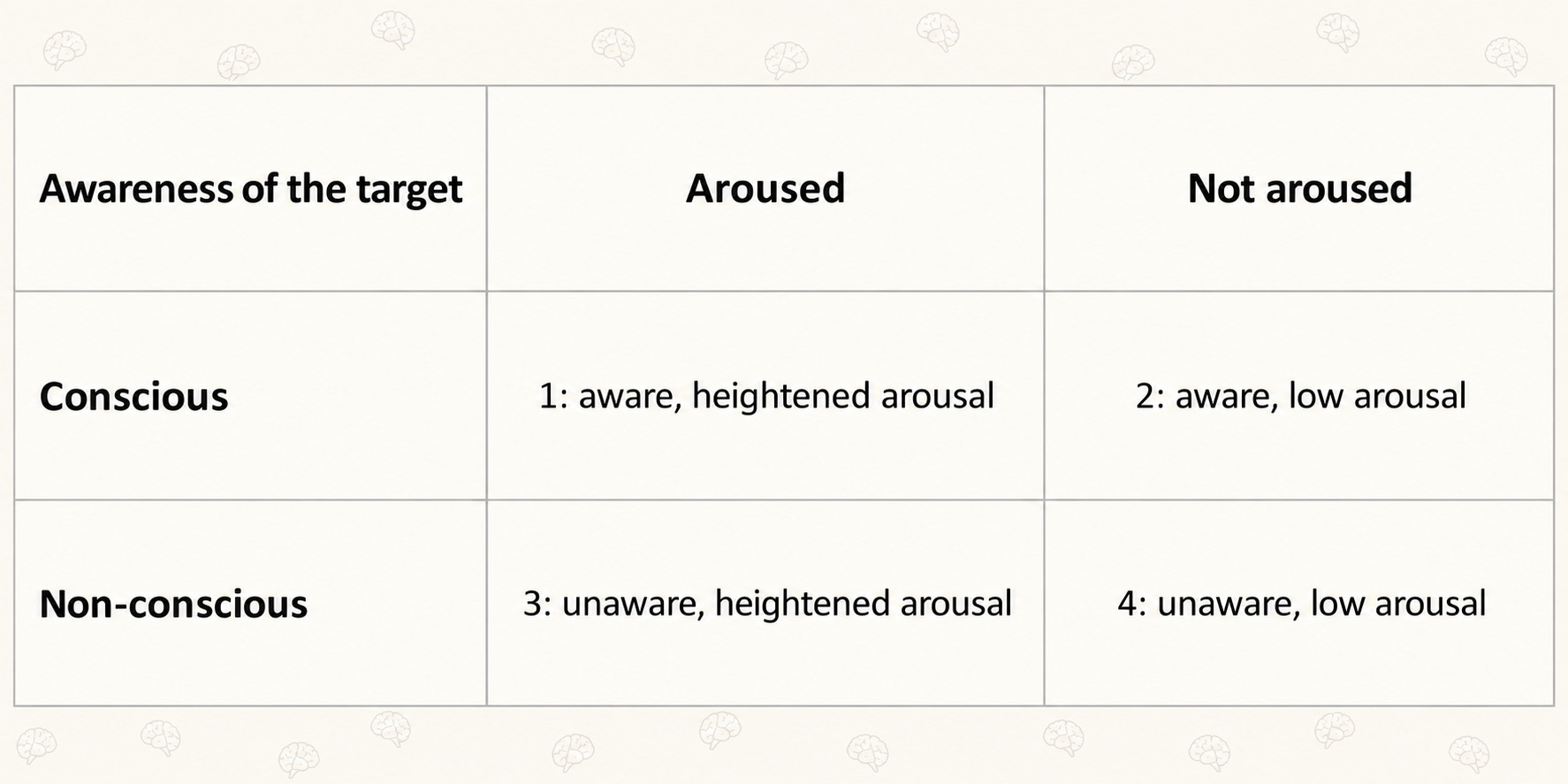
Everyone is awake during stimulus presentation. The rows concern awareness of one particular target. The columns concern the participant’s arousal shortly after learning, manipulated separately from the target’s content. The number of presentations stays the same across conditions. We need independent checks of awareness and bodily arousal, then the same type of memory test across all four cells.
Compare 1 with 3: following the arousal manipulation, does awareness predict better retention?
Compare 2 with 4: does awareness also predict better retention when arousal is low?
Comparing the 2-versus-4 difference with the 1-versus-3 difference tests whether later arousal changes the effect of awareness.
My conjecture is that awareness leaves a measurable signature in later memory.
Harari: a sliding scale objection
Yuval Noah Harari [12] asks what happens when a scientific measure becomes a reason to treat one being differently from another. He warns that rankings of consciousness could become rankings of whose suffering matters.
The concern reaches beyond comparisons between humans and other animals. A scale applied within humanity could give apparent scientific authority to claims that some people’s experiences count for less. Harari invokes the destructive history of racial theories as a reason to take that possibility seriously, even while the science is unfinished.
Some theories explicitly propose quantification [13]. Harari’s warning concerns what societies might do with such claims. He calls for caution about their consequences, especially when the theories remain uncertain.
Harari’s concern also reaches the zero point on a scale. Classifying a being as incapable of suffering can remove it from moral consideration altogether. The binary distinction I use here is much narrower: whether a particular event met the criterion for reported access within a single participant.
The crucial test
Could that signature be strong enough to tell us which events had entered awareness? I expect later memory performance to carry information about earlier reported access. If that relationship is reliable, later memory could provide a functional clue about prior conscious access.
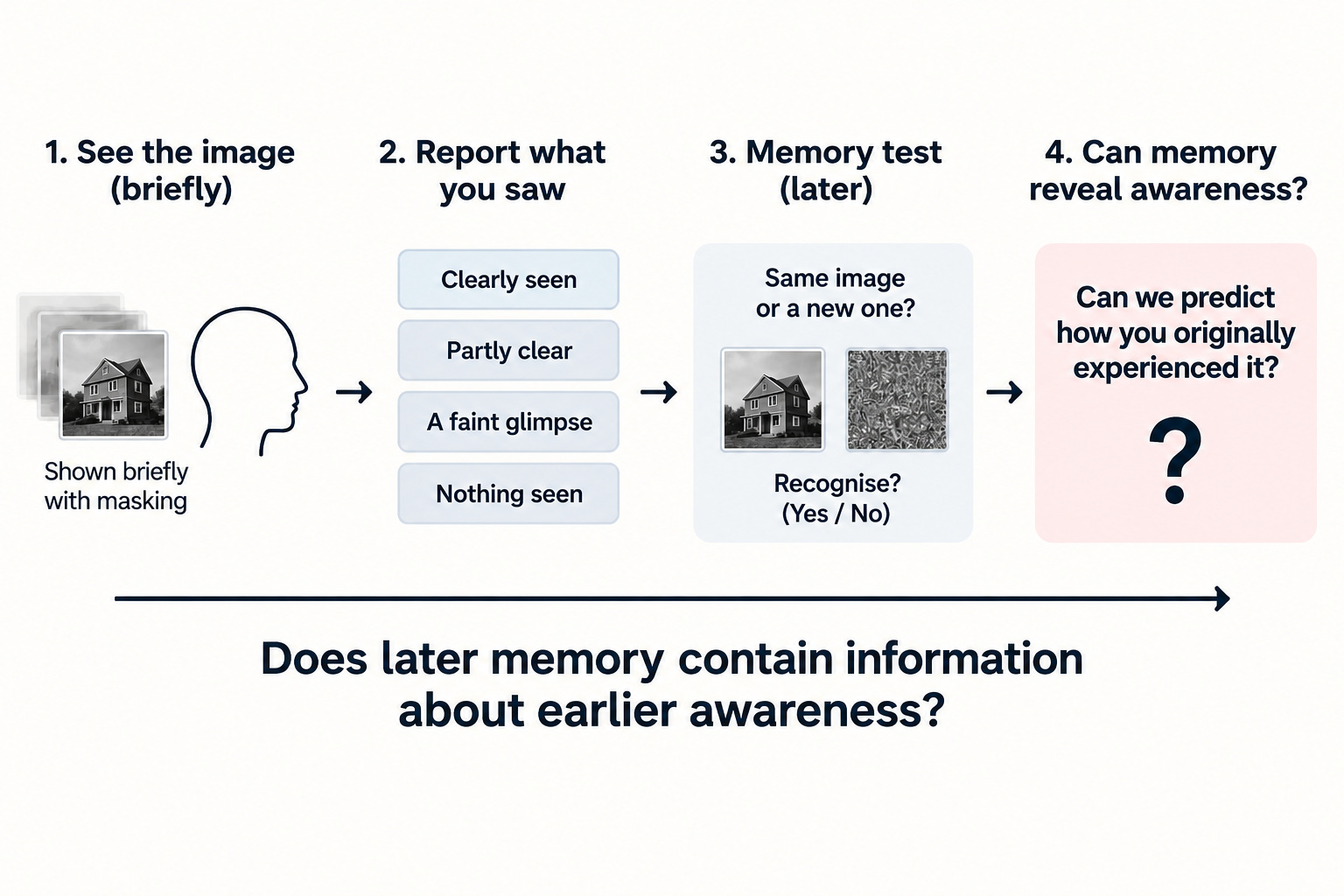
I would begin with cells 2 and 4: neutral images presented in a calm setting, with masking making some presentations difficult to see. Participants would rate their experience of each image as “nothing seen,” “a faint glimpse,” “partly clear,” or “clearly seen.” For the primary comparison, the three levels of visual experience would count as reported access. “Nothing seen” would form the other category. We would retain the full ratings to examine how memory relates to clarity.
Images would be randomly assigned to separate recognition tests shortly after presentation and the next day. Each image would appear in one memory test, mixed with completely new images. Participants would judge whether each image had appeared earlier and rate their confidence.
The early test would establish any initial recognition advantage for images reported as seen. That advantage could help explain why later memory predicts earlier access. At each delay, we would report recognition performance in each access category alongside prediction accuracy. Fading memory could weaken predictions by leaving less recognition evidence available.
Then we would work backward. Using recognition decisions and confidence, we would develop a rule for predicting each previously presented image’s original access category. We would evaluate that rule on a separate group of participants, checking its predictions against their original visibility reports. The scoring procedure would be fixed beforehand. We would report balanced accuracy, which averages the correct-prediction rates for the two access categories and has a chance baseline of 50%. We would also report uncertainty accounting for repeated responses from each participant, together with mistakes in each category. These results would establish how informative the memory responses actually are.
The experiment would quantify how reported awareness relates to subsequent memory, and how reliably memory indicates earlier reported access. Attention and sensory processing could contribute to both the original visibility report and later recognition. The findings would apply to participants completing this task; applications to people unable to report or to machines would require dedicated validation. The remaining arousal conditions would come next: how does a separate, emotionally arousing event change the memory advantage associated with conscious access, and the reliability of that advantage as a clue?
Whoever wants to write the Templeton or NSF proposal: good luck!
Intelligence without consciousness
Given how closely human emotions are tied to physiology, my working assumption is that LLMs do not feel emotions. My old friend Alexander Lerchner takes up the broader question of conscious experience in The Abstraction Fallacy [14]. He argues that computation alone cannot establish consciousness. Yet both humans and LLMs can display high intelligence. What does that tell us about the relationship between intelligence, emotion and conscious experience?
2026-09-07 #atoms #forces
References and further reading
Thomas C. Südhof, Stanford University School of Medicine. med.stanford.edu/profiles/thomas-sudhof
Ned Block, On a confusion about a function of consciousness (1995). This paper distinguishes subjective experience from access to information for reasoning, report and action, the distinction underlying my use of conscious access here. web.ics.purdue.edu
Jens G. Klinzing, Niels Niethard and Jan Born, Mechanisms of systems memory consolidation during sleep (2019). A review of how replay during sleep supports the gradual transformation and integration of memories across hippocampal and cortical networks. nature.com/articles/s41593-019-0467-3
Meike Ramon, Applied Face Cognition Lab. afclab.org/team
Denise Manahan-Vaughan, publication profile. sciencedirect.com
On LTP and LTD in information storage. academic.oup.com/cercor
Lee and Wilson, compressed replay of run sequences during slow-wave sleep. news.mit.edu/2003/dreams-0108
Daoyun Ji and Matthew A. Wilson, Coordinated memory replay in the visual cortex and hippocampus during sleep (2007). nature.com/articles/nn1825
James L. McGaugh, The amygdala modulates the consolidation of memories of emotionally arousing experiences (2004). A review of how stress hormones and the amygdala influence the consolidation of lasting memories. annualreviews.org
Morris, Öhman and Dolan, conscious and unconscious emotional learning in the human amygdala (1998). pubmed.ncbi.nlm.nih.gov/9990084
Joseph E. Dunsmoor et al., Emotional learning selectively and retroactively strengthens memories for related events (2015). An experiment showing that later emotional learning can strengthen memory for conceptually related neutral images encountered earlier. pmc.ncbi.nlm.nih.gov/articles/PMC4432479
Yuval Noah Harari, The Politics of Consciousness (2024). A lecture warning that attempts to measure or rank consciousness could influence whose suffering counts and who receives moral consideration. singjupost.com
Larissa Albantakis et al., Integrated information theory (IIT) 4.0: Formulating the properties of phenomenal existence in physical terms (2023). A theoretical account that links consciousness to a system’s causal structure and proposes Φ (phi) as a measure of the amount of consciousness. journals.plos.org/ploscompbiol
Alexander Lerchner, The Abstraction Fallacy. alex-lerchner.com/the-abstraction-fallacy