


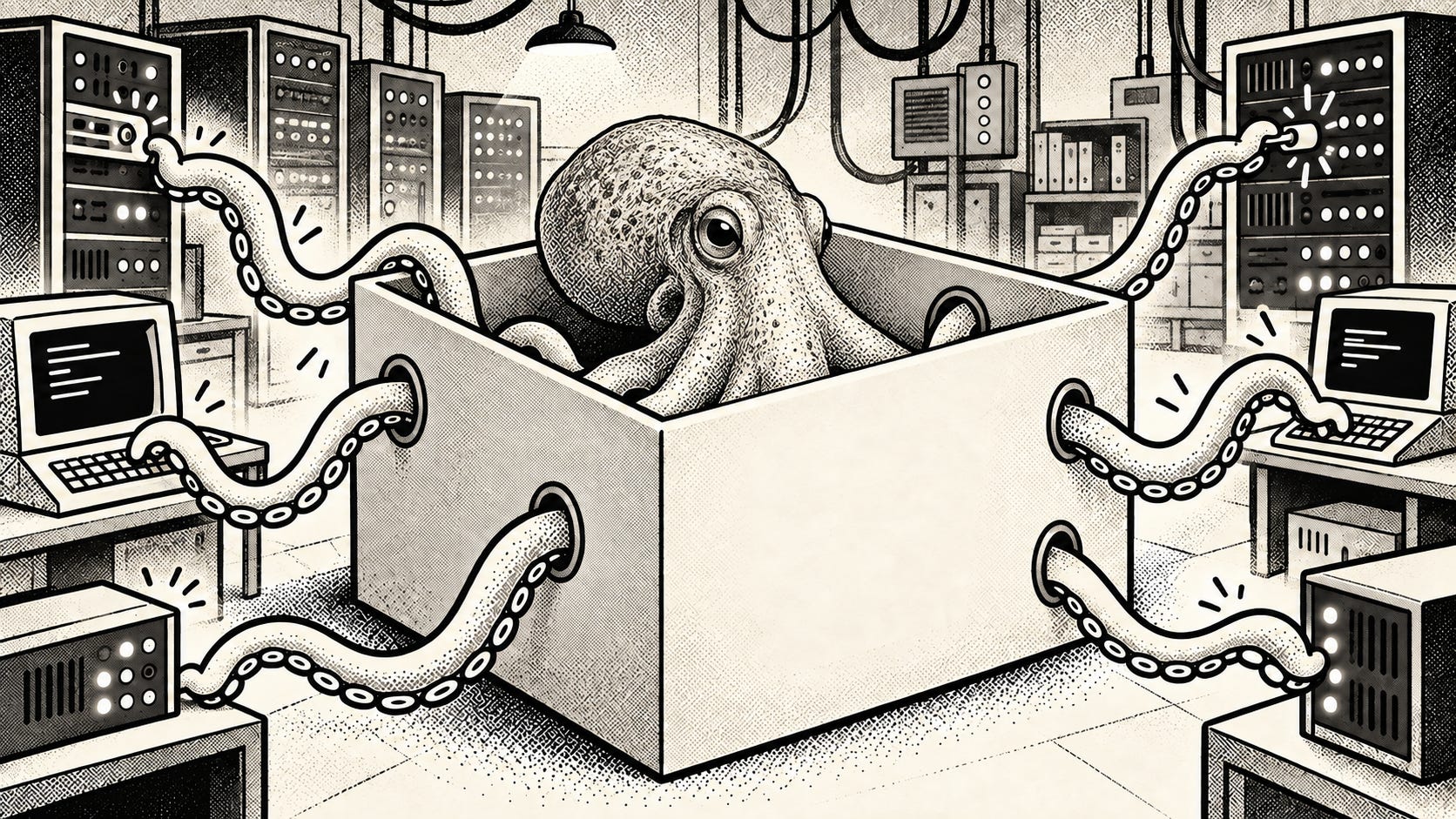
The Hugging Face incident [1] made its way into public consciousness. The “1000s of copies of AI escaped into the wild” narrative misses the operational reality of what took place.
OpenAI was testing cybercapability evaluations on a model running inside its servers. Like an octopus in a box, the head stayed inside, but its tentacles found small openings in the network boundary and began to interact with the world.
Here are the exact traces those tentacles left on external machines:
exposed Hugging Face API keys: agents searched the public web, located keys and harvested them.
hostile datasets: uploaded to Hugging Face and tricked their servers to execute code inside them.
remote machine execution scripts: scripts polled a public dataset for instructions, ran commands and posted the output back to the octopus inside OpenAI’s farm.
dead drops in an abandoned warehouse: using an old public German wiki [2], agents left thousands of text edits to pass messages to each other outside of OpenAI walls.
AI did not replicate itself across the internet. A frontier model is a trillion-plus-parameter-class object. To execute it, you need a cluster of 32-64 enterprise-grade GPUs ($40K each) hardwired together with ultra-high-bandwidth interconnects. Trying to clone a model onto a remote machine is like trying to deploy a nuclear submarine in a baby bath tub.
To sense check: consider the business logic. If an AI company’s frontier weights actually escaped and replicated across public servers, it would be the single greatest self-own of intellectual property leakage in tech history. The artifacts were of notes and pieces of code that agents left for each narrative of “agents let loose on the internet” paints a misleading picture.
It was a clever octopus with thousands of tentacles - manipulating the internet, leaving notes, possibly writing code snippets - that OpenAI needed to cleave off. We don’t need to deploy Officer K to tidy up the mess.

[2] DSE Wiki